

The Phase Shift Ahead

All our knowledge has its origin in our perceptions. — Leonardo da Vinci

Nicholas Georgescu-Roegen (The Entropy Law and the Economic Process, 1971) and his student, Herman Daly, are considered the fathers of Ecological Economics, the discipline that first highlighted the absurdity that conventional economic models neglected to recognize the second law (not theory) of thermodynamics, with profound adverse consequences for both people and planet. (Note: I was part of an unsuccessful effort to nominate Daly for a Nobel Prize for his courageous battle confronting the economics academy.)
Over a half century later, this profound insight is finally having a long overdue moment with the recent release of The Roadmap for Eradicating Poverty Beyond Growth under the auspices of the UN’s Special Rapporteur on extreme poverty and human rights, Olivier De Schutter. His mandate for this broad consultative process was to expand the range of policy options available to combat extreme poverty, in recognition of the failure of the Sustainable Development Goals that include the eradication of extreme poverty by 2030.
The key message of the report as the title implies is that economic growth is not delivering on its promise to “lift all boats.” At the same time, the report observes, growth is driving ecological overshoot and concentrating wealth to increasing extremes. This reality is what Daly cleverly called “uneconomic growth.” It is right out of the Costanza, Daly, et al, Introduction to Ecological Economics textbook, first published in 1997, and aligned with what Georgescu-Roegen warned us about in 1971. The 55-year (and counting) delay in this recognition has carried an indescribable cost, financial and moral, evidenced in part by both the European heat wave and fires this summer, and the half a billion people who remain in extreme poverty, insuring we will fail to meet the poverty goal of the SDGs.
For understandable reason, the political left and the right throughout the world have both been wed to the growth model since economics became a discipline, only disagreeing on the degree to which the State should participate in and how much to intervene in the growth centric system design. And we cannot underestimate how powerful economic growth is as a mechanism for wealth creation, notwithstanding the escalating costs of such growth. A radically higher degree of State intervention is now having its own moment from the political right in the United States. It has long been more accepted in more left leaning European social democracies, and of course is fundamental to the Chinese brand of capitalism.
The fact that two leading lights of mainstream economics, Joseph Stiglitz, winner of the Nobel Prize and a longtime advocate of replacing GDP as the primary indicator of economic progress, and Thomas Piketty, author of widely acclaimed Capital in the Twenty First Century (800 pages later and turns out the rich get richer) signed their names to a roadmap with “beyond growth” in the title is in fact quite a watershed event. In fairness, both are associated with the political left, and the report is focused on extreme poverty alleviation and not macroeconomic system design more broadly. But questioning growth has been the third rail in economics, so good for them to join many leading ecological economists as well as development economists in contributing to the report.
We can summarize the contrast between the neoclassical view from the ecological economics view as follows: perpetual growth enabled by technological innovation with no understanding of the relevance of entropy (mainstream view that continues to guide policy today), versus, the Limits to Growth reality that dates to the seminal Club of Rome report by the same name published within a year of Georescu-Roegen’s warning. Extremely controversial when published a half century ago, Limits to Growth has turned out to be remarkably prescient.
Ask most people on either the left or the right how to fix our economic problems, from affordability, to debt burdens, to retirement financing, to poverty, and you’ll be told to innovate, invest, and grow your way out of the problem. Ecological economics’ answer, in part reflected in the recommendations of the new Roadmap? The politically and practically difficult (impossible?) task of shrinking economic throughput back to the safe operating space of planetary boundaries without a new source of prosperity to replace it, and at the same time, share the smaller pie more fairly though institutional policies that redistribute the wealth in order to meet ethically desirable “social floors,” including the alleviation of extreme poverty. Because of the redistributionist bias, ecological economics can be confused for basic progressive economics of the mainstream left. But that would be underestimating the radical implications of acknowledging the limits to growth imposed by the entropy law (not a policy choice at all).
I want to suggest here that while these two camps represent alternative policy prescriptions, they share the same materialist paradigm. The paradigm, largely unexamined since Adam Smith as I’ve explained in my book on Regenerative Economics, models the economy the way Newton modeled the physical world: using the mechanistic logic of a machine. One side believes in an equilibrium seeking machine via the price mechanism, where growth is simply the natural state of the system running smoothly. A perpetual motion machine! The counter-argument, ecological economics, has spent now a half-century building the more accurate materialist case that this can’t be right: matter and energy are finite, entropy only runs in one direction, and an economy that treats the physical planet as an infinite input resource base and an infinite waste dump is, sooner or later, going to hit a wall.
The polycrisis is evidence we are hitting the wall, which likely explains the newfound willingness of some mainstream economists to at least begin to acknowledge reality, even if at this late hour. As a result of this delay in perception rooted in the naive model of neoclassical economics, we find ourselves seemingly trapped in the mother of all double binds. Economic growth has undeniably been the source of our prosperity (at least for some), and yet exponential growth is at the same time slowly but likely catastrophically undermining the health of the planet upon which life depends. Like a cancer cell, the organism—the economic system— is destroying its host.
Tightening the bind further by the day, the form of economic growth imposed by the unforgiving finance algorithm is increasingly concentrating wealth and power among the tiny slice of humanity who often share the naïve reductionist worldview that is the root cause of the polycrisis in the first place. Future historians will treat crowning the first trillionaire, unimaginable as recently as a decade ago, as a major indicator of the civilizational decay unfolding in our lifetimes.
The Good and Hopeful News
There is a plausible, though not simple nor quick way out of this double bind. I argue, usually without being understood because my view sits outside the modern age paradigm of materialism, that both sides’ perspectives are missing a promising and scientifically rigorous escape valve. And with this additional perspective, we can, if we choose wisely, find a pathway not only to survival, but to genuine and previously unseen prosperity. At issue is that both sides’ perception is confined to the materialist paradigm, the “clockwork universe” described by Newton’s mechanical laws. Not wrong per se, but limited unnecessarily.
In the face of the growing chaos of the polycrisis now impossible to ignore, people understandably want to act, not contemplate unfamiliar and as a result, challenging ideas. We need to be practical not theoretical is the command. But you can’t get where you hope to go without a map you can trust, and the one guiding most economic decisions right now is demonstrably bankrupt—see “polycrisis” for evidence.
Fixing the map isn’t a waste of precious time, an academic debate while the real work is delayed.
Fixing the map is the real work. Kate Raworth gave us an important start with her doughnut.
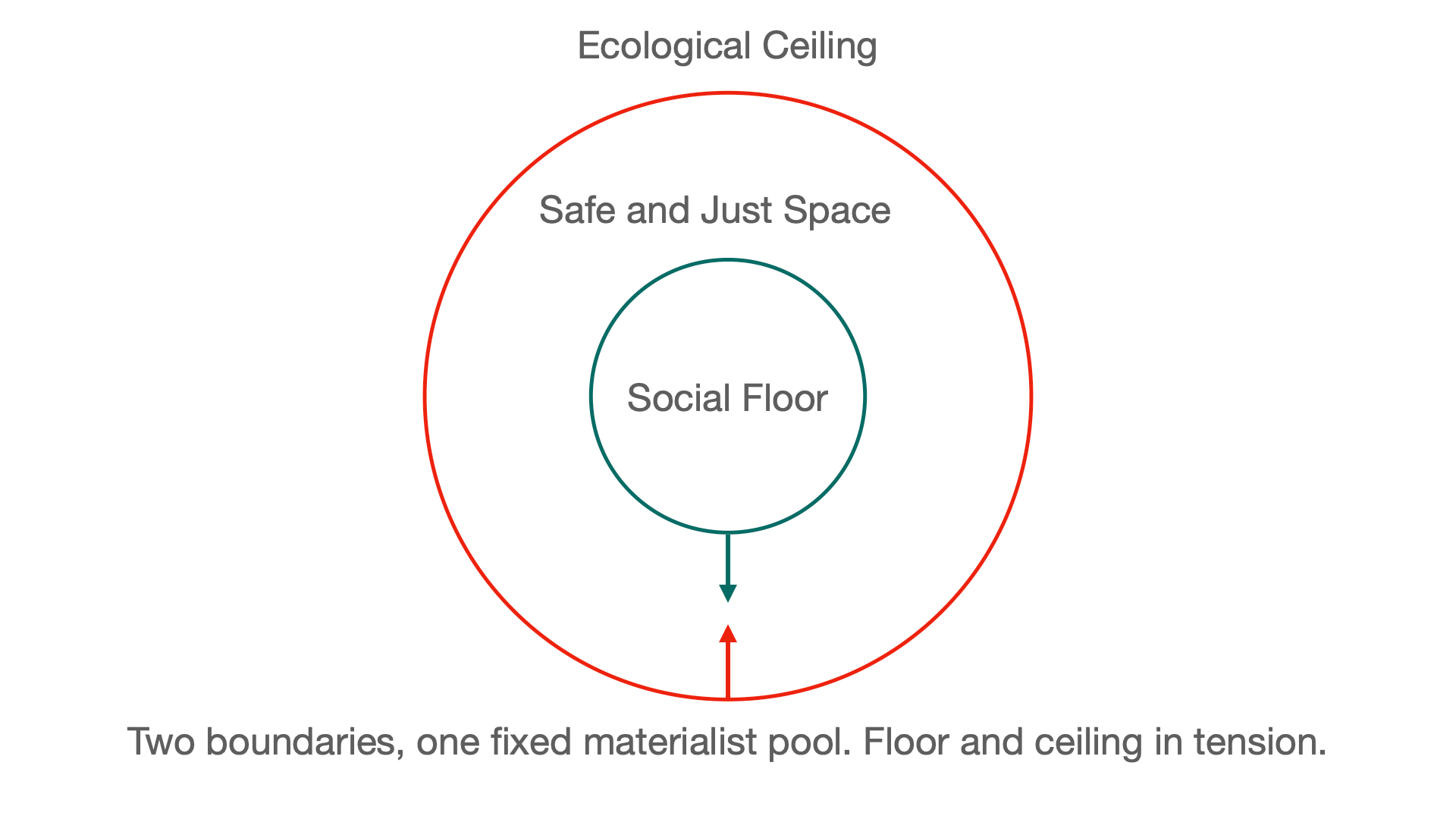
Kate Raworth popularized the critical insights of ecological economics into a simple and useful visual: a doughnut. Two rings, a social floor on the inside, and an ecological ceiling on the outside. Operate within the doughnut is the goal, replacing GDP growth. It’s a brilliant metaphor. But it is based on a splice, not one comprehensive analysis of a real complex system. The outer ring comes from Earth-system science (Planetary Boundaries), the inner ring from a political negotiation about what people are owed from a human rights perspective, derived from the United Nations SDGs.
The perception error hiding underneath the whole debate is the central hypothesis of Regenerative Economics:
An economy is not a machine that can be controlled and optimized. The human economy is a living system comprised of human beings, their institutions, and the tools and technologies they create, that must be nurtured in accordance with the patterns and first principles of living systems science.
Living systems don’t grow by simply doing more, and they don’t survive by simply doing less. They do something structurally different, and it’s been measured.
This isn’t a lone insight. Two very different bodies of thought converge on it. One tradition has spent half a century proving the material ceiling is real — thermodynamics, entropy, planetary boundaries. Another, older, transdisciplinary tradition — running through physics, complexity science, philosophy, cosmology, and consciousness studies — argues reality itself is generative, not just a fixed stock waiting to be divided up. Bridging the two is a body of hard ecological science: measured evidence that living systems, as they mature, actually behave the way the second tradition predicts, without ever violating the limits the first one proved. Eugene Odum’s 1969 study of ecosystem succession is the clearest piece of that bridge.
Odum found something profound and precise: as a system matures, the ratio of raw production to standing biomass falls, even as diversity and complexity (organization) keep rising. A mature living system in the real world, not in the abstraction of simplified models, isn’t doing more with more, and it isn’t doing less with less. It’s doing more with less, because it’s gotten better organized. That’s not a hopeful metaphor. It’s measured ecological data, and it lines up with the physics of how order actually forms in nature — not by cheating entropy, but by exporting it faster than it piles up.
If that pattern holds for economies, there is an opportunity to transcend the tension between the mainstream “grow more” camp (in violation of the second law), and the ecological economics “shrink and share” camp (not particularly hopeful even if possible to imagine politically). Importantly, it is not a third position on the same spectrum. It’s a different spectrum altogether. Not more stuff. Not less stuff (although less material throughput is certainly required). A change in currency: organization substituting for extraction and throughput, the same way it already does in every mature living system on Earth. This is the profound phase shift, from one state to another.
For example, consider the difference between a bed of weeds (Level 1 system) pouring all their energy into growth, and a mature rainforest (Level 3 system), defined by their complex organization not continuous physical growth.
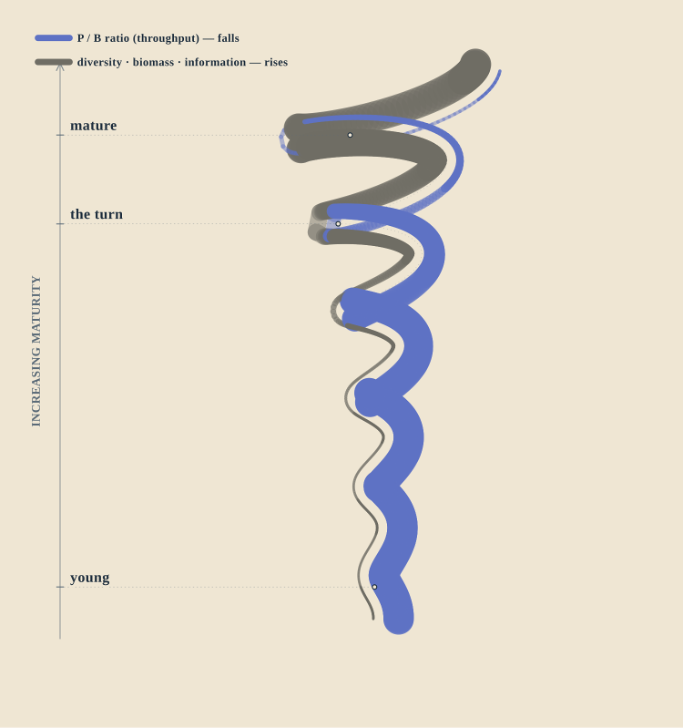
This is a radically different map: not two rings in tension, but a single rising spiral, climbing one axis of maturity. The ribbons hold Odum’s empirical data. The blue ribbon is production relative to standing structure (throughput), falling as the system matures. The grey ribbon is diversity and complexity (organization), rising over the same span. Where they cross isn’t a guess — it’s calculated, the point where the two are numerically equal. You and I my friends, happen to live at the moment approaching the turn. The phase shift ahead. If we get the organization right, we continue to spiral upwards as a mature system. If we don’t… (Diagram including calculations created with AI).
This is not a finished, tested map of what the global economy could be for obvious reasons. Such an economy does not exist at modern scale, yet. It’s a serious, working hypothesis — the same kind of reasoning that underlies evolutionary biology and plate tectonics. It’s abductive reasoning, inference to the best explanation, not deduction from certainty. Ecosystems demonstrate the mechanism that causes the phase shift to be observable (although not 100% of the time—life is complex!), through the slow, blind accounting of natural selection. Modern economies don’t yet have the mechanism. It will have to be designed in, on purpose.
The critical question at this time: Can the economy be designed to operate as all living systems seem to work, to the best of our understanding. And what is our role and responsibility as participants in this system? Certainly a focus on what we are calling system organization is paramount as a place to focus.
Different map, different imperative for our action. Interesting, right?
We are currently steering the global economy by a map that’s already failing on its own terms, for reasons we understand. Violating the second law, and ignoring the path dependency of time are unfixable and deadly flaws. Moving faster with smarter policies may mitigate the degree of collapse in front of us, and should be pursued. But using the wrong map is suboptimal at best. Much more likely, it will not get us where we want to go at all, and will likely create what we will call unintended consequence—potentially disastrous—of our inaccurate maps, a familiar pattern of modernity’s naïve “solutions” to complex problems.
The choice was never a perfect map versus no map. The overwhelming logic of abductive reasoning points toward the spiral, the natural evolution of an economy maturing from a level 1 system, on the way to a level 3 system. This raises profoundly different questions and resultant actions as the top priority in this moment. These questions are the right questions at this time.
The purpose of capital is to serve life, not the other way around. There’s an actual mechanism behind that sentence, not just a moral.
This is a summary of a forthcoming full paper on this topic describing the rigor behind the alternative lineages of the materialist paradigm and the generative paradigm. It will serve as the philosophical foundation of my book on Regenerative Economics. A paradigm shift is philosophical at its core, so we can’t shy away from it in our desire to be “practical.” My hope is that this short essay, and the longer paper, improve our perception, and with it our knowledge as da Vinci understood, of this phase shift transformation in economic system design, necessitated by our growing up from adolescence. Your feedback and critique is most welcome.
Thank you John. Your message is becoming more articulate, deeper, and may we hope more influential, with every writing. You are truly at the vanguard, and I have a sincere appreciation for how you recognize each shoulder you stand upon so reverently, and continue to recognize and bring attention to the many that are along side of you - a growing tide of intellect, comprehension, and compassion.
As I read this piece, I got an amazing forgotten insight to my long devotion to systems theory, ecological awareness, new paradigm generally, and specifically to the all the kin of ecological economics - I taught from Odum's text and papers in 1976, as a TA in Field Ecology at Providence College, under the tutelage of Gene "Doc" Donahue.
To me, the increasing diversity-biomass-information density of your new map illustrates Fritjof Capra's "system conception of life -- life organizes itself in networks, and these living networks are inherently regenerative, creative and intelligent."